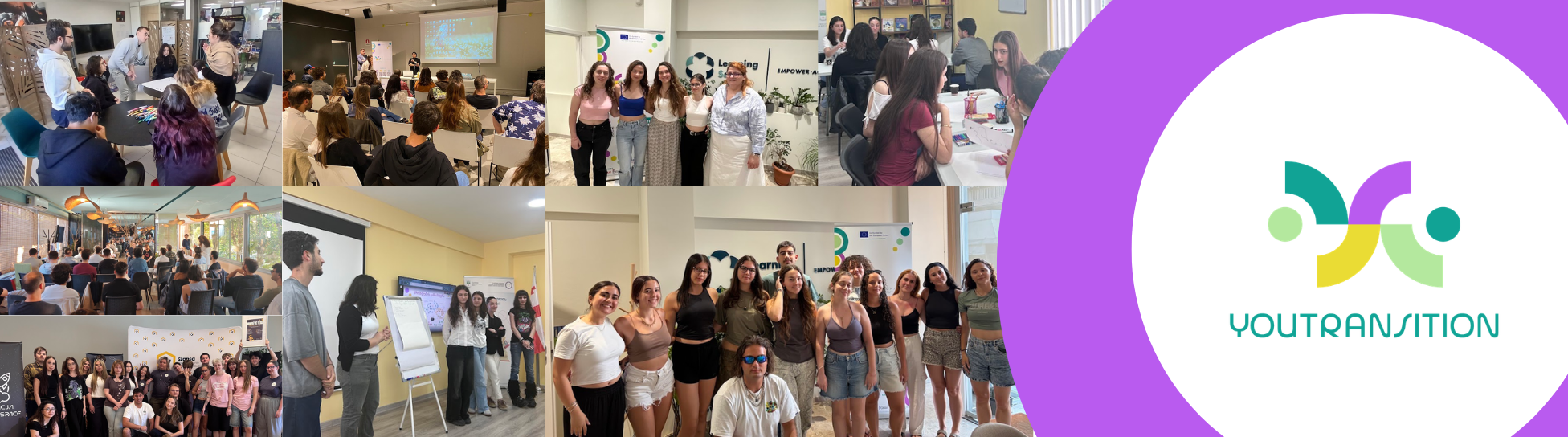
Under the architecture of the Erasmus+ partnership “Youth Seeds for a Just Transition” (YouTransition), a coordinated series of decentralized Grassroot events were deployed across six partner countries – France, Italy, Poland, Portugal, Greece, and Georgia – between March 2025 and June 2026.
223direct youth participants
6partner countries
2025›2026from March to June
This initiative activated a total of 223 direct youth participants, transforming complex, top-down socio-ecological concepts into community-rooted dialogues centered around regional vulnerabilities, public agency, and active citizenship.The primary ambition of the YouTransition Grassroot framework was to bridge the gap between abstract institutional definitions of a "Just Transition" and the everyday lived experiences of young Europeans.Across the entire project, local partners rejected the traditional, hyper-technocratic pipelines that frequently alienate young stakeholders or restrict their involvement to symbolic consultations. Instead, these events introduced non-formal education methods and collaborative problem-solving to achieve three interconnected systemic goals: de-siloing environmental and economic paradigms, safeguarding spaces for public advocacy, and capturing structured qualitative youth input to feed directly into the upcoming co-design of community services.
The localized execution of these principles revealed an extraordinary diversity of formats, each specifically tailored to the socio-economic realities of the respective territories.
FranceIn France, the
Ligue de l’enseignement Nouvelle-Aquitaine gathered 25 civic service volunteers at the Espace jeunes de Marmande for an intensive day titled “Young People Committed to a Just Transition: Act Here, Now.” By combining a multi-tiered horizontal expression wall with targeted World Café rotation dynamics and a dedicated territorial workshop called “Bouge ton territoire!”, the French event brought youth into direct contact with departmental public divisions to map local infrastructure gaps, public transport shortfalls, and systemic barriers to engagement in the Lot-et-Garonne region.
Italy · MilanConcurrently, Italian partners experimented with urban space ownership and creative planning.
AnciLab anchored its event at the Centro Culturale Il Pertini in Cinisello Balsamo (Milan), activating 29 young participants alongside local public and cultural associations.
The event, titled “Design Your Future!”, featured firsthand horizontal storytelling from peer ambassadors and tasked participants with mapping out actionable communication and interaction strategies for an upcoming local summer festival.
Italy · LecceFurther south, the
Municipality of Lecce joined forces with
Project School to deploy a two-tiered activation pipeline in the heart of Apulia. Their first event at Palazzo Carafa engaged 37 young citizens through real-time mapping tools like Mentimeter and interactive alignment matrices, challenging participants to analyze their current level of public influence against a multi-level index of participation. This was followed by a strategic session at Osteria Gazza Ladra, where 45 youth participants engaged in a live recording of the interactive Founders alla Spina podcast, debating green social entrepreneurship with pioneers from regional agricultural reforestation and peripheral urban street-art initiatives.
A profoundly distinct but equally vital cross-cutting focus emerged in Central and Eastern Europe, highlighting the intimate connections between structural change and youth well-being.
PolandIn Głogów, Poland,
Association CHANCE spearheaded a workshop titled “Youth without filter”. Engaging 23 participants and local civil society networks, the Polish event prioritized psychological safety through interactive positioning exercises, such as the “Cross The Line” activity, and structured challenge stations. Participants actively decoded the invisible pressures of educational burnout, mental health challenges, and the lack of youth participation in decision-making, producing a definitive collective declaration:
“Young people have a voice”
This central message reinforced the paradigm that emotional well-being, a sense of belonging, and institutional trust are non-negotiable prerequisites for sustainable civic behavior.
GeorgiaThis methodology found deep resonance in Lagodekhi, Georgia, where the
LEPL Youth Agency engaged 23 young participants and local Youth Council members at the Lagodekhi Media Library. Combining dynamic, non-formal icebreakers with split-group needs assessments, the Georgian event successfully mapped out international opportunity pipelines and networks for youth in remote agricultural regions.
GreeceIn Greece,
Learning Seed tackled geographical and communicative distance through a multi-stage approach named “RE-CITY: Our city through our eyes.” Running two consecutive events at their headquarters in Argos for 20 highly interactive young participants, the Greek organizers combined rigorous dialogue with a three-dimensional clay sculpting workshop, allowing participants to physically manifest their visions of territorial change, public utility, and hope.
To maximize the impact, this was complemented by a high-profile public dissemination activity at the historic first Greek Parliament building of Nafplio, expanding project awareness to an additional forty local stakeholders.
PortugalThe conceptual peak of this systems-based activation occurred in Braga, Portugal, where the
National Federation of Youth Associations (FNAJ) hosted the “Futures Under Construction Lab” at the Espaço Vita complex. Demonstrating great institutional agility, FNAJ chose to postpone its initial session to completely redesign its communication and visual layout, ensuring a highly dynamic and youth-friendly framing that gathered 21 associative leaders and municipal youth practitioners. To introduce systems thinking, facilitators engineered a kinetic simulation called the Human Triangles exercise, where each participant had to silently choose two peers and maintain an equal physical distance from them while walking. As every individual responded to invisible, shifting variables, a minor spatial adjustment by one person generated an automatic cascade of repositioning across the entire room. This visceral experience proved to the youth that societal challenges cannot be analyzed in isolation. Participants then utilized a collaborative canvas to trace how hyper-individualism, lack of professional opportunities, low economic productivity, and digital illiteracy reinforce social collapse and environmental degradation.
When analyzing the macro-impact of these events, several cross-cutting thematic conclusions emerge.
First, European youth explicitly reject a linear definition of the ecological transition, emphasizing that environmental actions cannot be separated from social justice, regional equality, and democratic inclusion.Second, individualism and institutional distance are recognized as the most significant barriers to collective action, which positions youth associative clubs and communal spaces as vital hubs for rebuilding public trust.Finally, the evaluation mechanisms across all countries revealed exceptional satisfaction; the Italian event in Cinisello Balsamo recorded an average score of 4.71 out of 5, with 88% of participants requesting permanent inclusion in future networks, while the Georgian event achieved a perfect five-point quality rating.
4.71/5average score in Cinisello Balsamo
88%request permanent inclusion in the networks
5/5perfect rating for the Georgian event
The conclusion of these decentralized Grassroot events marks the completion of the first diagnostic phase of Work Package 2. The local knowledge, youth-led definitions, and trust-based networks built during these months are being automatically channeled into the next phases of the project lifecycle.Partners are currently transitioning from problem definition to structural prototyping through regional Hackathons and Youth Public Innovation Labs, where participants will utilize Transition Design tools to build physical public service frameworks.To secure a permanent legacy, these localized tools, strategies, and case studies are being systematically compiled into remote educational resources for the AnciFAD digital platform, ensuring that the seeds sown during these grassroots labs will continue to empower youth organizations and changemakers across Europe for years to come.